

Tough Draw Tuesday: Carlee Otero’s Pursuit of 1%
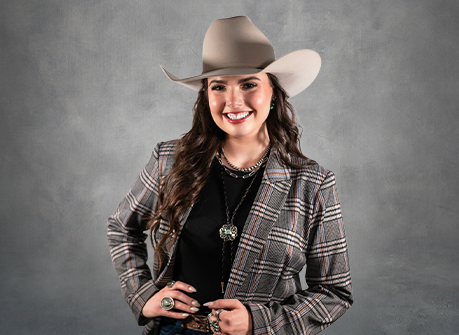

When people look at Carlee Otero today, the accomplishments are easy to see.
She’s a five-time Wrangler National Finals Rodeo qualifier, a member of the WPRA Million Dollar Club, and one of the most respected competitors in professional barrel racing. She’s currently sitting inside the top five of the WPRA barrel racing world standings as she continues a season with real gold buckle potential.
She is also one of the newest members of the Tough Draw Sports roster, adding another accomplished horsewoman, competitor, and business owner to a group built around athlete-first representation.
Those pieces of her story deserve recognition, but they are not the whole story.
The full picture includes humble beginnings, a young mother still chasing a dream, businesses built between rodeos, injuries that tested her toughness, and three horses she once could not have imagined having on the trailer at the same time.
In the middle of all that success, one detail from Otero’s story says as much as anything.
A $500 horse.
Starting With What She Had
Otero grew up around horses and rodeo, but not in the way many people might assume.
Her father was a bullfighter and later became a rodeo judge. Her mother grew up cutting, running barrels, and competing in several events. Horses were always part of the family, but the money required to junior rodeo and travel extensively simply was not there.
Instead, Otero stayed home, rode ranch horses, and learned to make the most of what was available.
“Everything that I do now, I feel like came from just doing everything right at home,” Otero said.
That foundation became important later.
By the time she was 20, Otero was a mother. She had a son, Kale, and a life that could have easily pushed her childhood dream to the side. Instead, she remembers recognizing that motherhood had not erased what she still hoped to build.

“I know I’m a young mom, but I still have dreams,” Otero recalled thinking.
The horse that helped her see a path forward was not expensive or finished. His name was Tar Baby, and Otero bought him for $500.
“He was not anything fancy,” she recalled. “I worked really hard. My mom helped me.”
Together, they developed him into a competitive horse and eventually sold him for $10,000. At the time, that number felt huge. More than that, it showed Otero that she could take what was available, improve it, and use that progress to create the next opportunity.
“I thought I won the world just being able to do that,” Otero explained. “There wasn’t a money tree in our backyard.”
From there, she began working through more horses, learning which styles fit her, what type of training she could ride behind, and how much work it would take to move closer to the level she wanted to reach.
That $500 horse was a starting point for a lasting career.
The Pursuit of One Percent
That early lesson still shows up in the way Otero approaches almost every part of her life.
Professional rodeo requires horsepower, resources, timing, travel, and the ability to keep moving when the days are long and the plans change. Otero built a career in real estate, continued growing other business interests, and learned how to keep working while the miles kept adding up.
During summer run, that work does not stop.
“We drive more than we do anything else,” Otero said.
Between rodeos, she is often returning calls, managing real estate clients, working with her team back home, thinking through her next run, or talking with Michael about what can be better in the next arena.
The schedule would be enough for most people. For Otero, it is part of the system.
“I want to improve at least 1% every single day,” she explained. “I want to be better, whether it’s personally or in competition.”

When things start to feel comfortable, Otero starts looking for another place to improve. Sometimes that means refining her physical preparation. Sometimes it means becoming more efficient in business. Sometimes it means sharpening her horsemanship or simply trying to be better to the people around her.
The subject changes, but the standard does not. Stay sharp. Keep working. Find another percent.
A Dream Team on the Trailer
That same mindset is part of what makes Otero’s current horse string so meaningful. Today, she travels with Sly, Regina George, and Twix.
“They’re literally my dream team,” Otero shared. “If I look back 25 years ago, I never even imagined that I would’ve had three good ones at one time, and all three of them at any arena, any rodeo, will go win first place.”
All three are 8 years old, but each came into her life differently.
Sly has been with Otero the longest. She got him at the beginning of his 4-year-old year and took a chance on a horse that was wild, difficult, and far from guaranteed to become a professional rodeo horse. After a year of seasoning, he proved his worth.
“He loves it,” Otero said. “It’s what he loves to do.”
Sly helped carry Otero back to the NFR in 2024 after a decade away from Las Vegas. Then, after Houston the following year, he was injured, and Otero was told he was not expected to make a comeback.
With Sly sidelined, the original plan changed.

Twix entered the picture first, giving Otero reason to believe the 2025 summer run could still become something meaningful. Regina George followed shortly before summer run after spending roughly 18 or 19 months turned out following an injury. Otero initially agreed to exercise her, then had the opportunity to buy her only weeks before Reno.
It was a risk. Otero took it.
Reno became Regina George’s first major competition with Otero, and she set the arena record before it was later broken during the same event.
The summer that began with uncertainty had introduced Otero to two more horses capable of competing at the highest level. Eventually, Sly worked his way back, too.
“The great horses are few and far between, and I literally have three of them,” Otero said. “I’m so blessed. I get speechless even talking about them.”
Each horse brings something different.
Regina George may have a name that suggests attitude, but Otero describes her as quiet, relaxed, and content to conserve her energy until it is time to work.
“When I get on her, it’s like we mesh, and she knows, ‘OK, Mom’s on me. It’s time to do work,’” Otero said.
Sly is the opposite. He is proud, explosive, and always on the muscle. He does not need many runs to stay sharp, and Otero said he seems to get faster when the crowd gets louder.
Twix is more reserved, intelligent, and businesslike. She is quiet, independent, and steady enough to travel across the country by herself.
Together, they mark the result of years spent learning what to look for, when to take a chance, and how to keep building when the first plan falls apart.
No Question About Continuing
That approach became even clearer during the 2024 NFR.
Before Round 5, Otero was kicked near the trailers while getting ready for the barrel race. The impact fractured her pelvis, and her right leg initially went numb. She was advised to get checked for internal bleeding and warned against running until the severity of the injury was known.
When asked whether she questioned continuing, her answer was immediate.
“I never questioned it,” Otero said.
Michael finished saddling and warming up Sly, then lifted Otero onto her horse because she could not safely mount on her own. Otero competed that night and placed second.
“I have no idea how I did it,” she reflected. “It was by the grace of God.”
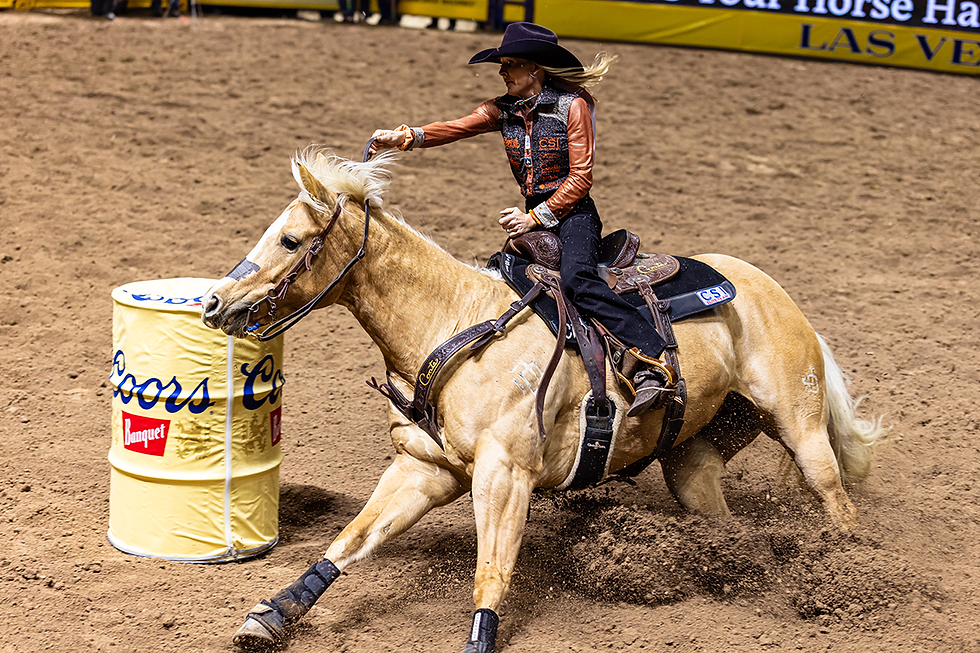
Afterward, she learned there was no internal bleeding, but the injury would typically require six to eight weeks of rest.
“We don’t have time to rest,” Otero remembered thinking. “Are you kidding me? I still have rodeo to do.”
For the rest of the Finals, Michael continued helping her get on and off her horse. When she returned home, she took two weeks to rest before sending a horse to Denver and flying in to compete. Even then, she could not get on by herself.
That was when tie-down roper Monty Lewis saw her struggling and stopped to help lift her onto her horse before his own run.
Otero went on to win Denver.
The story says plenty about toughness, but it also says something about the rodeo community around her. It also changed the way she thought about the sport and the chance to keep doing it.
“Anything could happen, so I’m gonna enjoy this ride,” Otero said.
The Circle Behind the Season
For Otero, none of it works alone.
Her life on the road is supported by a circle that includes family, clients, agents, sponsors, and especially Michael, her husband and teammate in almost every part of the journey.
Michael, a former NFR qualifier, understands the rodeo lifestyle because he has lived it. He drives most of the miles so Otero can work from the road. He exercises horses, keeps the feed program in order, handles the details at home, and supports the schedule required to chase another trip to Las Vegas.
“He is so supportive,” Otero said. “I’m not sure that this circle would continue moving without him.”
That kind of support matters because Otero’s life is not divided neatly between rodeo, family, business, and horses. All of it moves together. She is a wife, mom, grandmother, realtor, horsewoman, entrepreneur, and competitor, and each role has helped shape the way she approaches the next one.
The discipline required in real estate carries into rodeo. The competitive drive required in rodeo carries into business. The patience required with horses carries into everything else.
None of it stands alone.
Partnerships Built to Last
That same sense of alignment shapes the way Otero thinks about sponsors and partnerships.
Early in her professional career, she was excited when companies wanted to give her product or put a patch on her shirt. Over time, she learned that the strongest relationships had to be built on more than that.
“It has to be 100/100 on each side,” Otero said.
For Otero, the fit matters. She wants to believe in the products, people, and companies she represents. She also understands the reality of professional rodeo: travel is expensive, horses are expensive, and visibility at the highest level carries real value.

That perspective lines up with the way Tough Draw Sports approaches athlete representation. A good partnership should support the athlete, serve the brand, and create something with enough trust and respect to last beyond one season.
Otero has become clear about what she wants from those relationships.
“I would rather have less sponsors, but ones that are gonna last a lifetime,” she explained.
That line says a lot about the way she approaches the sport. More is not always the goal. Better is.
The Bigger Picture
After years of rodeo, Otero is still chasing more.
Making the NFR is always a goal, but for Otero, the full measure of success reaches beyond qualifying.
“I feel like I have a true chance to go in there and win the world,” she said. “If I can show up and just do my part, my horses can do it.”
That confidence is not accidental.
It comes from the years spent building horses, running businesses, recovering from injuries, showing up for sponsors, and finding ways to improve even when no one else sees the work happening.
It also comes from a deep respect for the sport itself.
Otero believes barrel racing is growing, not only as an event, but as an industry. The horses are getting better. The riders are getting better. The money has grown. Fans are paying attention.
“They’re following us,” Otero said. “And it’s exciting. I love it.”

That growth matters to her because she cares about the future of rodeo, not just her own place in it.
When asked what she hopes people remember when her career is over, Otero’s answer did not center on records, money won, or even NFR qualifications.
“I hope that they remember that I was always a light to somebody,” Otero said.
She talked about stopping for photos, supporting the sport, and making sure young fans feel seen even when the schedule is tight.
“I always wanna be known as an ambassador of the sport that I have so much passion and so much love for,” she said.
One Percent at a Time
Carlee Otero’s story is easy to summarize through accomplishments.
Five NFR qualifications. A place in the WPRA Million Dollar Club. An elite string of equine athletes. A season with championship potential.
But the more meaningful part of the story is how much came before the accomplishments became visible.
A $500 horse. A young mother with big dreams. A family that taught her to work. A business built to support the road. A fractured pelvis that did not stop her. A husband and circle willing to help keep the whole thing moving. Three horses that arrived through timing, risk, faith, and years of preparation.
That is the nature of 1%.
It rarely looks dramatic in the moment. It shows up in the small decisions, the late nights, the early mornings, the calls returned from the road, the horses cared for between runs, and the willingness to keep improving long after success would have made comfort easier.
Otero is proud of what she has built, but the clearest sign that more may still be ahead is the way she talks less about arrival than improvement.
She is still building.
One horse, one opportunity, and one percent at a time.
Continue the Conversation
This week’s Tough Draw Tuesday was inspired by a recent conversation with Carlee Otero on Tough Draw Talks.
In the full episode, Otero shares more about her beginnings, the family and businesses supporting her life on the road, her recovery from a fractured pelvis, her approach to partnerships, and the very different personalities of Sly, Regina George, and Twix.
Listen to the complete conversation with Carlee Otero on Tough Draw Talks on Spotify or Apple Podcasts.
For Otero, one of the early opportunities that changed her life happened to be a $500 horse.
What small opportunity or decision changed the direction of your life or career?
We’d love to hear those stories in the comments.


Comments